One of the biggest risks in the automation market in 2026 is conceptual confusion that leads to disappointment. Business owners hear “AI” and assume everything called a bot works the same way — but the difference between a classic chatbot and a real AI agent directly determines whether your customers stay or walk away.
This article explains the difference in plain language, and why it becomes critical right now — when 39% of businesses in Israel already integrate AI (CBS Israel, 04/2026).
Definition: What Is a Classic Chatbot
A classic chatbot is built on decision trees. The business owner (or the configuring agent) sketches a flowchart:
If the customer writes “appointment” → show buttons [first appointment | follow-up | cancel] If they pick “first appointment” → ask “What type of treatment?” If they write “price” → reply “See link [price list]”
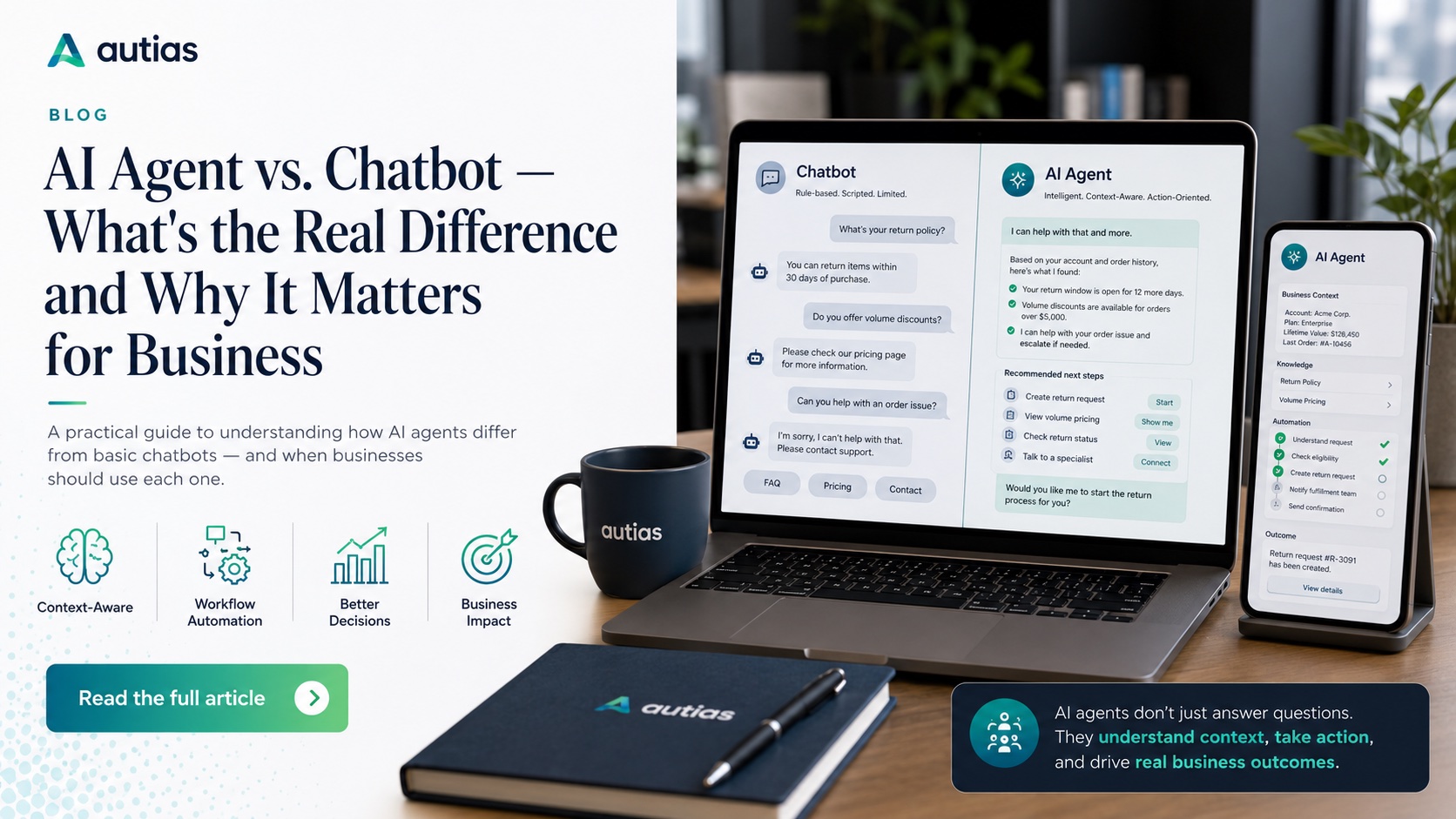
The bot follows that script deterministically. If the customer writes something you didn’t anticipate — for example, “Is your treatment suitable after surgery?” — the bot falls back to a default response (“I didn’t understand, please try again”) or offers the wrong menu.
Popular classic chatbot platforms: ManyChat, Tidio, Chatfuel, and similar SaaS tools.
Definition: What Is an AI Agent
An AI agent for business (a conversational AI agent) operates differently. Instead of a decision tree, it rests on two components:
- A large language model (LLM) — understands natural language, including nuance, varied phrasings, and typos
- A knowledge base for your business — the website, the FAQ, training documents, procedures, catalog
The agent receives a question, looks up the relevant answer in your knowledge base, and constructs a contextual reply. The question doesn’t have to be phrased in a way you predicted in advance.
Example: a customer asks, “I’m recovering from back surgery — is your physiotherapy a fit?” An AI agent trained on the clinic website will identify that you have a therapist specializing in post-surgical rehab, and provide a relevant answer. A classic chatbot will most likely show the wrong menu or hand off to a human rep.
The Differences at a Glance
| Aspect | Classic chatbot | AI agent |
|---|---|---|
| Logical foundation | Decision tree (if-then) | AI model + knowledge base |
| Handling unexpected questions | Default fallback | Tries to answer from context |
| Fit for the specific business | Manual, limited | High — learns your content |
| Maintenance | Update tree for every change | Update knowledge base (much easier) |
| Typical monthly price | ₪80–300 | ₪250–800 + setup |
| Hebrew support | Partial | Full (model-dependent) |
| Concept’s vintage | Late 1990s | 2022+ (commercial LLMs) |
Why This Matters for Your Business
The technical difference may sound academic. In practice, it affects four concrete business channels:
1. First Contact Resolution
A classic chatbot that only handles pre-planned scenarios will hand off to a human rep at every deviation — which loads up the team, lengthens wait times, and lowers first-contact resolution. An AI agent can resolve 70–85% of conversations without human involvement (provider-based estimate).
2. Customer Satisfaction
Customers hate the feeling of “I’m talking to a robot that doesn’t get me.” A chatbot that replies “I didn’t understand” three times burns trust. An AI agent responds in a human tone and in context, and customers sometimes don’t realize it’s automation (and that’s fine — being transparent about AI use is good practice).
3. Conversion to Paying Customer
In verticals like clinics, online stores, and B2B services — the complex questions arise at the moment of decision. If the customer asks, “How much will it cost me exactly in my situation?” and the chatbot offers a menu instead of an answer — the conversation is lost. An AI agent will read the context, provide a range, and propose a next step.
4. Long-term Maintenance Cost
A classic chatbot demands manual updates on every product/service change. An AI agent needs a knowledge base update (a text or document) — a process 3–5× faster.
The Risk: Confusing the Two Concepts
One of the biggest problems in the market in 2026 is that many vendors call their chatbot an “AI agent” for marketing reasons. A business owner who doesn’t distinguish between the two may pay a premium for a product that’s a decision tree with a fancy name.
How to check before you pay:
- Ask: “Does it learn from my knowledge base, or do I need to define scenarios manually?” — an honest answer is the best signal.
- Request a demo with a question you didn’t plan with them — for example, a question specific to your business. See if it responds in context or falls back to a default.
- Check the monthly price — if a solution is marketed as “AI” and costs ₪80/month, it is almost always a classic chatbot with a polished label.
When a Classic Chatbot Is Actually the Right Choice
Not every business needs an AI agent. A classic chatbot is a legitimate choice when:
- Inquiry volume is low (fewer than 50/month) — the AI agent setup cost won’t be recouped
- The scenarios are simple and repetitive (e.g., “What are your hours?” + “How do I get there?”)
- The business knowledge base is thin — there isn’t enough content to feed an AI agent
See the full guide to the difference between DIY, turnkey, and custom development for an informed decision.
How We Build AI Agents at Autias
Our agent rests on two foundations:
- A knowledge base we build with you — pulled from your site, FAQ, training booklets, internal procedures. A 3–7 working-day process
- Integration with the WhatsApp Business Cloud API and your CRM — not just a conversation, but full logging of every customer. See the AI agent service for the full technical breakdown
Before we start, we run a consultation call and check together whether this step fits you. Book a call.
Notes: Price ranges are based on the Israeli market as of 04/2026 (source: providers). Not a commercial offer. First-contact resolution rates are market estimates — they depend on the specific business and the quality of the knowledge base.